
'This is not a time for bruised egos, face, shows of state power, petulance, or PR spin. It is a time for big-tent action across a table -- no matter how acrimonious -- with transparency, and with the media present,' notes Vijay Verghese.

The Eternal Gandhi Museum is the only Gandhi-related museum in the United States, dedicated to Gandhi, to preserve and promote his ever-lasting legacy of nonviolent conflict resolution.

Delhi has been wrapped in a security blanket for Tuesday's 77th Independence Day celebrations, with more than 10,000 personnel manning the area in and around the Red Fort from where Prime Minister Narendra Modi will address the nation, the police said.
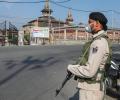
A thick security cover has been thrown around the BJP office at Jawahar Nagar in Srinagar where Shah is likely to pay a visit.
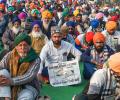
Farmer leaders also announced their plans to block the Kundli-Manesar-Palwal expressway for 24 hours on April 10.
In a section entitled 'Sikh Extremism' the review goes into detail of how members of the British Sikh community expressed their growing concern over a small but extremely vocal group "hijacking" the Sikh faith to push a subversive pro-Khalistan narrative.

Almost all will say no. Then ask them why they don't push back at those who rise the slogan of Khalistan. Somebody would confront you with a counter-question: If people can talk of a Hindu Rashtra, why get so upset if others talk of a Sikh Nation, points out Shekhar Gupta.

Most political leaders in Punjab have come out in the open to oppose him, unlike the early 1980s when political leaders were scared of speaking against Bhindranwale, observes Sudhir Bisht.

Multiple layers of iron and cement barricades, and at least five layers of concertina wires were put up last year, and further strengthened after the January 26 violence this year during the farmers' protest against the three contentious farm laws.

The thing is that unemployment and joblessness are a personally felt shame. It is not easy to mobilise a set of people who identify with others as a group that cannot get work, asserts Aakar Patel.

India's majoritarian regime is now making a dangerously fast-paced move towards theocracy, like its western counterpart did a few decades ago, warns Mohammad Sajjad.

The death toll due to COVID-19 rose to 543 and the number of cases climbed to 17,265 in the country on Monday, according to the Union health ministry.

Empowerment of the National Investigation Agency (NIA) with extra territorial jurisdiction and declaration of Maulana Masood Azhar, Hafiz Muhammad Saeed, Zakiur Rehman Lakhvi and Dawood Ibrahim as terrorists after legislative amendment were counted among its achievements by the MHA, headed by Union Home Minister Amit Shah.

'At this moment, the Trinamool has an edge.'
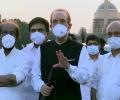
A day before the start of the Budget session of Parliament, as many as 18 opposition parties, led by the Congress, the Nationalist Congress Party, the Shiv Sena and the Trinamool Congress, decided on Thursday to boycott the President's address to the joint sitting of both Houses in solidarity with the farmers protesting against the new farm laws.

Sandeep Pandey salutes women who have contributed to social transformation in India after 1980.
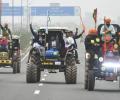
'The PM cannot give a single reason why farmers should trust him.'

Hours after the macabre crime, a man wearing the blue robes of the Sikhs' Nihang order appeared before the media, claiming that he had 'punished' the victim for 'desecrating' a holy book.

BJP MP Satish Gautam demanded the expulsion of Uttar Pradesh Labour Minister Swami Prasad Maurya from the party for calling Jinnah a 'mahapurush'
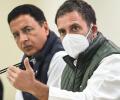
Congress leader Rahul Gandhi on Friday warned that the farmers' agitation will spread across the country if not resolved soon and asserted that the only solution to the issue was to throw the new agri laws in the 'waste paper basket'.

The Emergency greatly influenced the RSS' makeover from a fringe force in the Indian political imagination to one that could have its own man sworn in as prime minister in two decades' time. A riveting excerpt from Christophe Jaffrelot and Pratinav Anil's India's First Dictatorship: The Emergency, 1975-1977.

In any institution that has a passionate ideology, the moderate is always vulnerable to the person who is more extreme, because that is what the supporters want.

We may be witnessing a slow erosion of the democratic republic and the emergence of the police State, warns Sunanda K Datta-Ray.

'I can't help it if people don't love the minorities, the Dalits and Adivasis; they are as much of this country as any other Indian.' 'If I love them, it does not mean I do not love my country.' 'It is ironic and funny that they have laid such severe anti-national charges against me.'
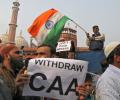
'After the NRC in Assam, things have changed for Muslims in India.'
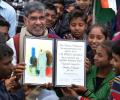
After receiving the Nobel Peace Prize on Wednesday and captivating the minds of people around the world for his simplicity and modesty, Kailash Satyarthi, the engineer-turned-child rights activist, returned home to India from Oslo on Saturday night.

'The situation is especially serious in major hotspot districts or emerging hotspots like Ahmedabad and Surat (Gujarat), Thane (Maharashtra), Hyderabad (Telangana), and Chennai (Tamil Nadu),' the MHA statement said.

'Gandhi turned his life into a counter-intuitive experiment in old ideas like non-violence and swadeshi.' 'He offered numerous universal ideas that talk to the human condition.' 'His ability to take risks was outstanding,' says Sopan Joshi, explaining why the Mahatma's ideas are as relevant as ever.

President Ram Nath Kovind addressed the nation on the eve of India's 75th Independence Day. Here's the text of what he said:

Here's the full text of President Ram Nath Kovind's customary address to the joining sitting of Parliament on the first day of the budget session.

India's Kailash Satyarthi received the Nobel Peace Prize for 2014 on Wednesday, sharing it with Pakistan's Malala Yousafzai, the youngest ever Nobel laureate, for their work on promoting child rights in the troubled sub-continent, where millions are deprived of their childhood and education.
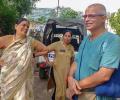
Maharashtra police on Tuesday raided the homes of prominent Left-wing activists in several states and arrested at least five of them for suspected Maoist links. Near simultaneous searches were carried out at the residences of prominent Telugu poet Varavara Rao in Hyderabad, activists Vernon Gonzalves and Arun Farreira in Mumbai, trade union activist Sudha Bhardwaj in Faridabad, and civil liberties activist Gautam Navalakha in New Delhi. Subsequently, Rao, Bhardwaj and Farreira were arrested. Although Navalakha was also arrested, the Delhi high court ordered police not to take him out of the national capital at least until Wednesday. According to unconfirmed reports, others whose residences were raided are Susan Abraham, Kranthi Tekula, Father Stan Swamy in Ranchi and Anand Teltumbde in Goa. The raids were carried out as part of a probe into the violence between Dalits and the upper caste Peshwas at Koregaon-Bhima village near Pune after an event called Elgar Parishad, or conclave, on December 31 last year. Here are their brief profiles:

'I don't see people standing up against what is happening in Kashmir. I feel this clampdown can exist as long as the government wants it to.'

'A nation can take a quick decision in a fit of passion or excitement that can be damaging to itself in the long term,' says Aakar Patel.

'It is not about trusting the governor but the ground situation not matching with what he has said,' Jammu and Kashmir People's Movement chief Shah Faesal, who was one of the leaders to meet the governor tells Rediff.com's Prasanna D Zore.
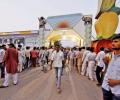
Deras like Sacha Sauda made the poor feel secure, cared for, loved, provided a support system and gave them dignity, says Sanjeev Nayyar.

Calling people of the northeastern region by "derogatory" names will soon become a non-bailable offence and land you in jail for up to five years.

Kailash Satyarthi, co-winner of the Nobel Peace Prize, in front of packed crowd made a rousing speech asking every person to come together and set our children free. He honoured those who came before him and also said that he accepted this honour on behalf of all the martyrs and activists in India. Here's the transcript of his moving acceptance speech.

We present our alphabet of 2020, pulling in everything you'll remember about this year we'd rather forget.

If there is a lesson to be learnt from the 1980s, it is that mobocracy never works. And a government that yields before public protests will have ceded its right to govern, says Syed Firdaus Ashraf.
